
How KAIRIX builds reliable surgical workflow applications.
Less administrative work.
Software built around your practice’s rules, on infrastructure you control.
30 minutes. Free. No preparation needed.

Built inside a surgical practice.
Around the work that matters.
Administrative work takes time away from patients and leaves revenue uncollected. We know because we've worked inside the practice.
The cost can show up as staff time spent chasing paperwork, delayed scheduling, and revenue left uncollected—not as a single line item on a P&L.
KAIRIX was built inside a physician-owned neurosurgical group, by the people running its referral pipeline. That experience shaped our approach: measure the work, understand the practice's rules, and build around the people doing it.
More tools. The same bottlenecks.
Fix the workflow—not just the workload.
Generic software
Standard tools leave staff bridging gaps between systems.
Consultancies
A plan still needs a team and budget to build it.
Internal IT
Workflow projects compete with security and maintenance.
What changed
KAIRIX combines your practice rules with AI document reading. We measure first, build to scope, and keep staff in control.
30 days. Four clear deliverables.
We interview your team and measure the workflow. You keep every deliverable, whether or not you build further.
- 01
A measured baseline
Touches, handoffs, delays and drop-off—counted, not estimated.
- 02
Process and data-gap map
Duplicate entry, missing data and decisions without evidence.
- 03
Ranked, scoped build plan
Priorities by hours and revenue, with rules, access and success measures for the first build.
- 04
A working platform
Running in your environment, connected to agreed systems and ready for the first custom build.
Fixed fee. Thirty days. Baseline, build plan and working platform. No commitment to build further.
Only if you proceed. $70K total, with the full $30K diagnostic fee credited.
Recurring, scoped separately to each workflow and the value it addresses. Agreed before you proceed.
Starts with a 30-minute introductory call. The call is free and separate from the diagnostic.
Your rules do the work. Your staff make the call.
Your rules guide routine work. AI reads documents and flags exceptions. Every action is logged.
- 01Ingest
Fax, portal, PDF, EHR queue
- 02Structure
Pages into a dated record
- 03Apply rules
Your intake and routing logic
- 04Hold exceptions
Anything unresolved waits
- 05Review and approve
Person approves, then the record is updated
What we need from IT
- Scoped system access
Read/write access only to agreed systems, approved by your IT team.
- Infrastructure you control
Your server or private VPS. Your team decides data location and access.
- Your security review
IT and compliance review access and governance before live use.
No EHR migration or replacement is part of the build.
Where people stay accountable
- A named person signs off
Referral acceptance, routing and chart updates wait for coordinator approval.
- Evidence beside the decision
Source pages, matched fields and applied rules appear beside each proposal.
- Exceptions stop, they don't guess
Anything outside the encoded rules is held for a person. Silence is never treated as approval.
From kickoff to launch
Optional first-agent launch: target day 60 from kickoff, subject to scope, system access and security review.
Measure the work, map the gaps, scope the build and set up your platform.
If you proceed: build, pilot with 2–3 coordinators, address issues and train the team.
One referral processed in 1 minute, 42 seconds.
Read the packet. Match the patient. Check eligibility. Propose routing. A coordinator approves before any update.
manual touches per referral
days to a scheduled appointment
of referrals converted
closed with no reason recorded
Baseline measured at one 40-surgeon development-partner practice before the build. Not a benchmark for other practices, and not an outcome.
One timed run on de-identified practice data, from receiving the fax to updating the EHR record. It measures processing time for a single referral — not a clinical outcome or a conversion result.
Choose a workflow to see what the coordinator reviews.
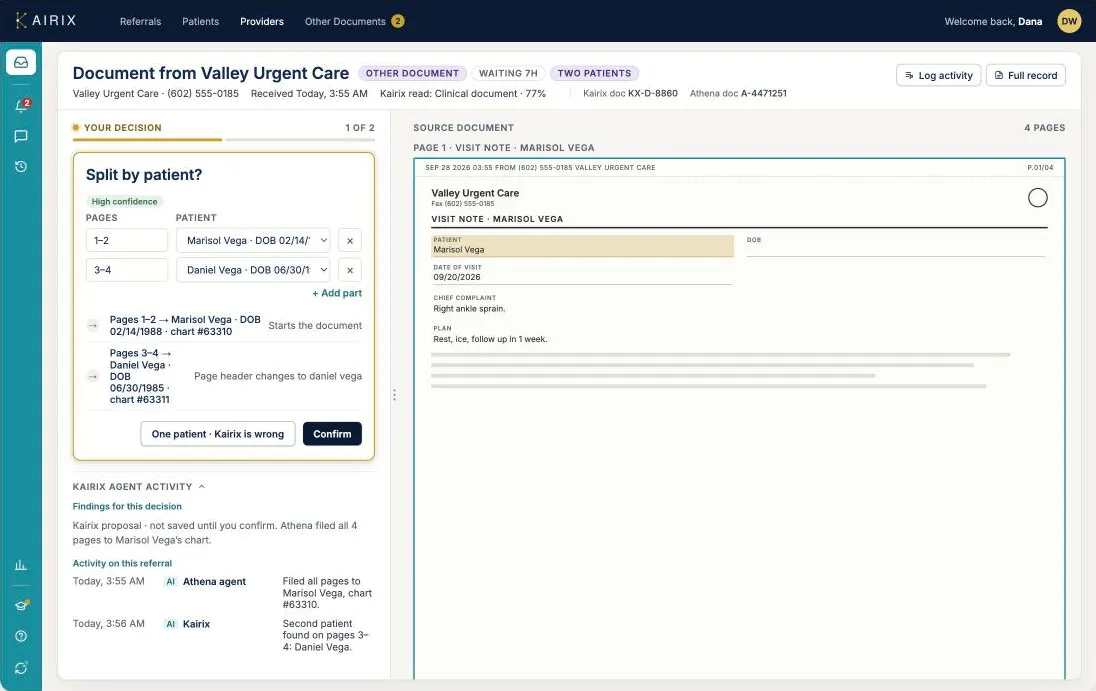
The agent noticed the page header change on page 3 and proposes filing pages 1–2 and 3–4 to separate charts. Nothing is saved until the coordinator confirms — or marks it wrong.
Available today—and what’s next.
Applications come out of diagnostics. Each is configured to the practice's own rules, and each keeps a person on the decision.
Referral Intake
Read packets, match patients, check eligibility, propose routing and record closure reasons. Coordinator approval before updates.
Insurance Verification & Prior Authorization
Assembling the authorization request from the record against payer requirements, before authorizations expire.
Surgical Scheduling
Completing scheduling forms and sharing date changes with everyone involved. Not part of the referral intake application available today.
Underpayment Recovery
Comparing payments against contract terms to find shortfalls. Shortlisted for scoping; not built.
Potential workflows to assess during a diagnostic. Not available today.
- Imaging review preparation
- Cancellation waitlist
- Pre-surgery confirmation outreach
- Visit-length scheduling
- Denial pattern monitoring
- Coding verification

Built for your institution.
Custom tools for hospitals and academic departments. Your infrastructure. Diagnostic first.
- Custom surgical AI models
- EHR and surgical-system integration
- Practice-specific workflow automation
- On-premise or private-cloud deployment
For the practice, and for the service line.
Start with one practice or one service line.
Physician-owned specialty practices
- Designed for 10–60 providers
- A practice-led decision
- Works alongside your existing EHR
- Your server or private VPS
Hospitals and health systems
- Start with one surgical service line
- A focused pilot with a measured baseline
- Works with existing systems
- Use the first pilot to guide expansion
Start focused. Measure what changes.
Operating briefs behind the diagnostic
UnitedHealthcare cut 1,700 prior auths. Which of your cases changed?
UnitedHealthcare's prior authorization cuts took effect October 1. Most practices can't yet say which of their cases are affected, or whether turnaround is improving.
Read brief →The Missing Metric: Measuring Referral Leakage
Twenty-six percent of referrals close without a recorded reason. How practices can instrument their pipelines to find where revenue is actually lost.
Read brief →
83 days on a 72-hour clock: what Medicare’s AI pilot exposes
New records from Medicare’s AI prior-auth pilot show long delays. The more useful question for surgical groups: Do you know your own authorization numbers?
Read brief →The practices that move first won't just keep up.
They'll define what comes next.
Don't wait for a roadmap or settle for a report. We measure the cost of administration, build the agent that takes the work back, and return the hours to care.
$30K fixed fee. Thirty days of interviews and instrumentation.
Delivers a baseline, a scoped build plan and a working platform.
No commitment to build.